Pest Control Service Frederick homeowners actually need begins with identification, not a spray wand — the pest gets named, the entry point gets found, and only then does anything get treated. We work across Frederick County, from Downtown Frederick Historic District rowhomes with shared brick party walls to newer construction in Spring Ridge, Villages of Urbana and Ballenger Creek.

Pest control service in Frederick, MD is a professional inspection-and-treatment service that identifies the specific pest present in a home or business, locates and seals the entry points it used, applies targeted treatment inside and around the structure, and verifies the result at a scheduled follow-up visit.
Every service reflects the same meticulous attention to detail — whether it's a single job or a larger pest control service project across Frederick.
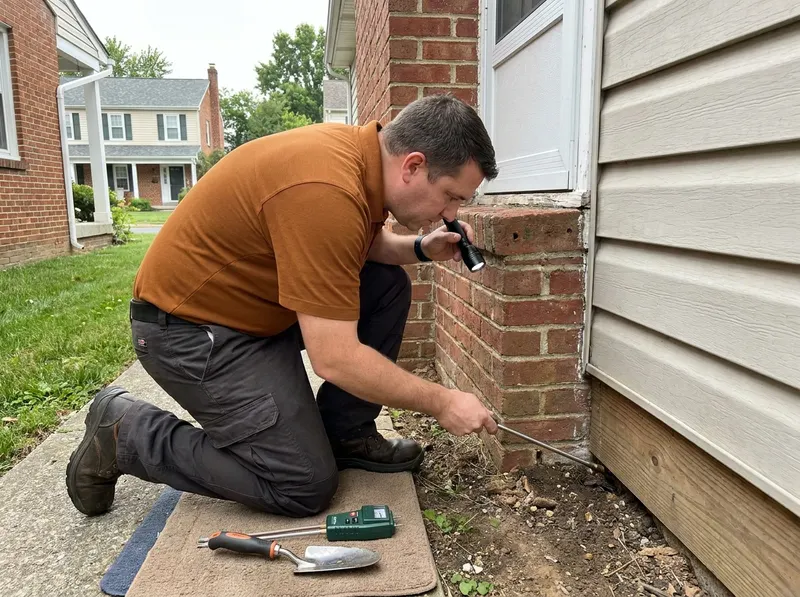
A termite inspection covers crawl space and basement sill plates, the foundation perimeter, exterior trim, and any wood in soil contact, looking for mud tubes, discarded wings, blistered paint and hollow-sounding framing. Subterranean termites are active across Frederick County, and swarms peak March through May — a cloud of winged insects at a basement window in April is the most common way people find out they have a colony. Findings are written down with locations noted, whether or not treatment follows. This inspection matters most before listing a home, after a real estate inspector flags something, or when nobody has looked at the crawl space in a decade. We identify it before we treat it, and an inspection that finds nothing is a legitimate outcome you should be able to walk away with.
View details →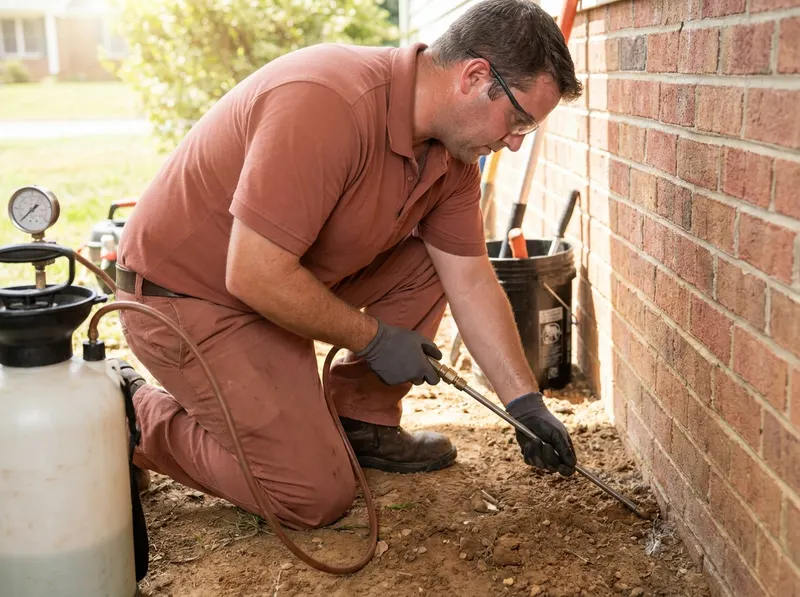
Termite treatment in Frederick homes is most often a liquid soil barrier: trenching the exterior foundation, treating at the label rate, drilling and treating through slab sections where a porch, stoop or garage floor blocks access, and treating interior activity found in the crawl space or along basement framing. Colonies feed on structural wood from the ground up, so the soil line is where the work happens. Frederick's clay-heavy soils and the older stone-and-brick foundations near Baker Park and the Downtown Historic District both change how a barrier gets applied and how much drilling a job takes, which is why the price is confirmed on site rather than quoted blind over the phone. Follow-up verification is part of the job — a treatment nobody re-checks is a receipt, not a fix.
View details →
A termite bait system places in-ground monitoring and bait stations around the structure at set intervals, then relies on foraging workers to carry an active ingredient back to the colony. Installation runs $1,000 to $2,500 with annual monitoring of roughly $250 to $450, and stations get checked on a schedule so activity shows up in a record rather than a guess. Baiting fits Frederick homes where trenching would mean cutting through a paver patio, a finished basement wall, or mature foundation plantings a homeowner is not willing to lose. It works over months instead of days, so it is the wrong choice when a settlement date is two weeks out and the right choice when nobody is under a deadline.
View details →
Bed bug treatment starts with confirmation: live insects, shed skins, or the dark specks along mattress piping, box spring corners, headboard joints and baseboard seams. Bed bugs travel on luggage and secondhand furniture, not on dirt, and they turn up in immaculate homes in Worman's Mill, Spring Ridge and the Villages of Urbana as readily as anywhere else. Treatment targets harborage — seams, frames, voids, outlet plates — rather than open floor, and you get a written prep list because prep does half the work. A verification visit follows roughly two weeks later, since eggs hatch after the first cycle and a single missed cluster restarts the problem. Anyone promising one visit and no follow-up on bed bugs is guessing.
View details →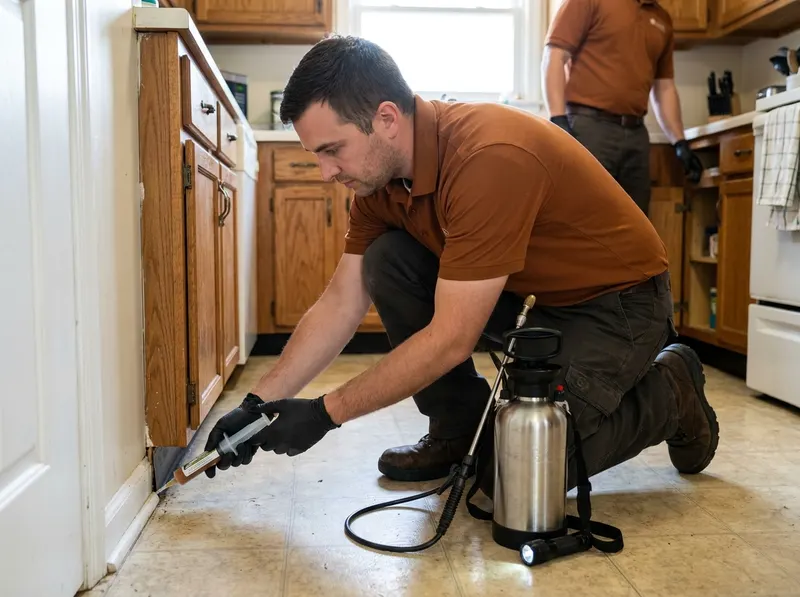
German cockroach control in Frederick kitchens uses gel bait and targeted crack-and-crevice placement inside the harborage — behind the dishwasher motor, under the sink lip, inside the range control panel, along the refrigerator gasket, in the hollow of a hinge plate — plus a sanitation plan for the grease and crumbs feeding the population. Roaches are hard to eliminate here for three reasons: a single female carries an egg capsule holding roughly 30 to 40 eggs that no spray penetrates, they live in warm voids you cannot open, and in the shared walls of Downtown rowhomes and multi-unit buildings they simply walk back in from next door. That last point is why treating a single unit in a shared building rarely holds without addressing the neighboring wall . Two to three visits is normal, and the second visit is where the result is decided.
View details →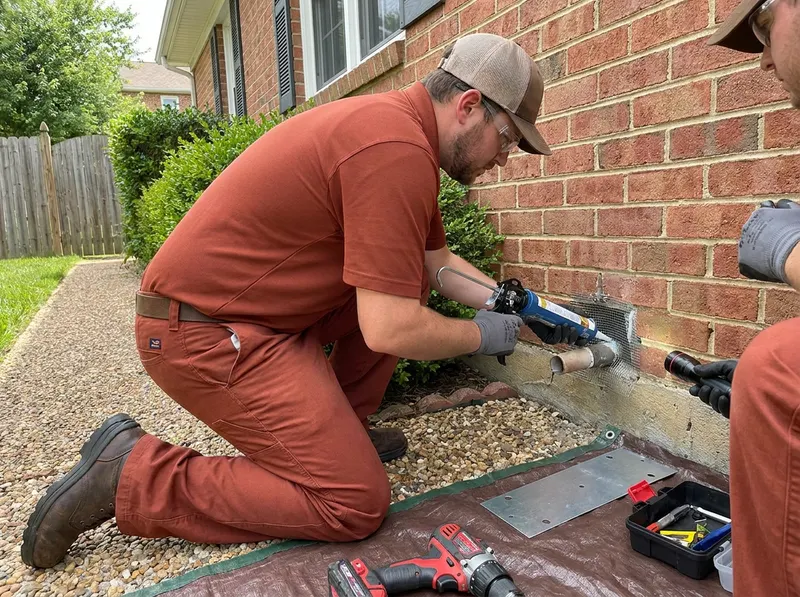
Rodent work is trapping plus sealing, in that order and never one without the other. A house mouse fits through a gap the width of a pencil — about a quarter inch — so the inspection maps every opening: sill plate gaps, utility and dryer vent penetrations, garage door corner seals, crawl space vents, gaps behind kitchen cabinet toe kicks, and the space where a deck ledger meets siding. Traps go in runways and along walls where droppings and rub marks show travel, not in the middle of a floor where nothing walks. Rodent calls in Frederick climb sharply October through February as mice move into basements and garages, and fall exclusion appointments should be booked before the first hard frost. Sealing stops the cycle; trapping alone resets it every few weeks.
View details →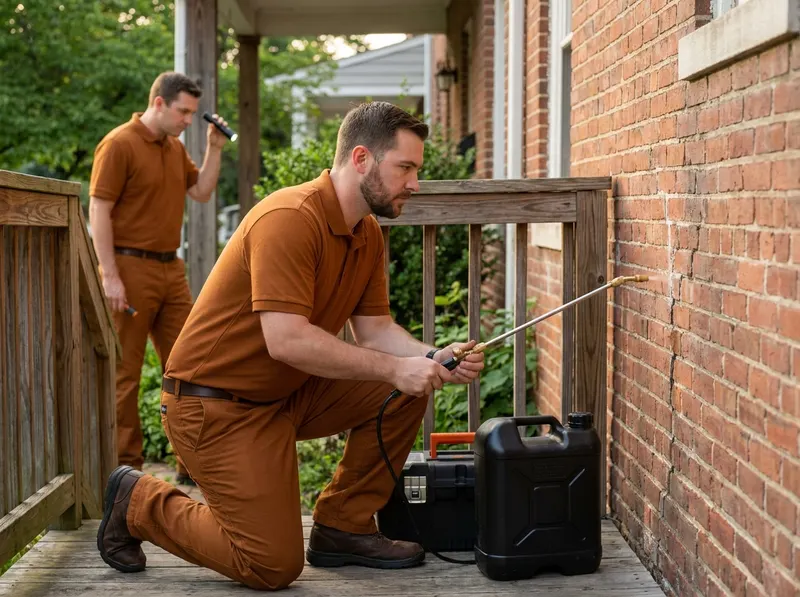
Carpenter ants are the large black ants, roughly a quarter to a half inch long, that leave small piles of coarse sawdust-like frass below their galleries. They excavate wood rather than eat it, and they follow moisture — a leaking gutter line, a deck ledger board, window trim under a failed caulk joint, or roofline framing behind an ice-dam stain. Treatment locates and treats the parent nest and satellite nests, treats trailing routes along foundation and cabling, and identifies the moisture source that made the wood soft enough to be attractive. Homes bordering wooded edges near Tuscarora Knolls, Clover Hill and the Gambrill State Park side of the county see the heaviest activity. Frass without mud tubes usually means ants rather than termites, and that distinction changes both the fix and the price.
View details →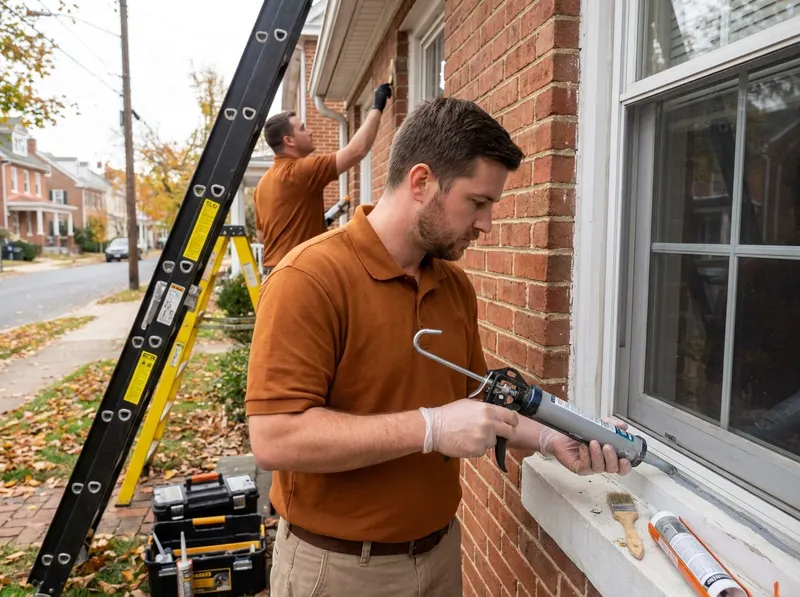
Brown marmorated stink bug exclusion is exterior work done before the bugs arrive: sealing around window and door frames, gable and soffit vents, attic penetrations, dryer and bath fan terminations, siding gaps and the seam where trim meets masonry, plus an exterior perimeter treatment on the sun-warmed south and west walls they gather on. Stink bugs enter Frederick County homes in large numbers from late September through October, and once they are inside a wall void the honest answer is that vacuuming is the practical option — which is exactly why the work belongs in late August or early September. Homes near farm field edges, orchards and the tree lines around the Monocacy National Battlefield take the worst of it. Sealing in autumn also cuts the number of bugs that reappear on a warm February afternoon.
View details →Pest control service in Frederick, MD is a professional inspection-and-treatment service that identifies the specific pest present in a home or business, locates and seals the entry points it used, applies targeted treatment inside and around the structure, and verifies the result at a scheduled follow-up visit.
You get a firm, itemized quote for your pest control service before any work begins — no surprises, no pressure.
Careful prep, tidy work, and a full cleanup when we are done. We treat your home and belongings like our own.
The same trusted, background-checked team from the first call to the final check.
The real decision in Frederick is rarely which chemical — it is one-time fix versus ongoing coverage, and exclusion versus treatment. If you have a single, contained problem with an obvious cause — one yellowjacket nest under a deck stair in Hillcrest, a bathroom mouse that came in through a garage door corner seal, carpenter ants trailing from one moisture-damaged deck ledger — choose a one-time treatment with exclusion, and expect $250 to $650. If the pressure is structural and recurring — a Downtown Frederick rowhome sharing walls with two neighbors, a restaurant kitchen with a nightly food source, a wooded lot backing onto the edge of the Frederick Municipal Forest — choose quarterly service, because the source sits outside your control and re-entry is continuous. The trade-off is honest: one-time work is cheaper up front but only holds if the entry points are sealed and the sanitation changes stick; quarterly service costs $250 to $350 per visit but keeps a perimeter that never gets a chance to build. For termites, liquid soil barriers and bait systems solve the same problem two different ways. A liquid barrier trenched around the foundation treats the whole soil line at once and runs $1,200 to $3,200 on a typical Frederick home — that matters when mud tubes are already inside a crawl space or when a pre-listing inspection just flagged activity and a settlement date is fixed. A bait system installs at $1,000 to $2,500 with annual monitoring of roughly $250 to $450, works over months rather than days, and suits homes where slab construction, finished basements, patios or hardscape make full trenching impractical. The trade-off is speed and disruption versus digging: the barrier is faster and more invasive, the bait is slower and leaves your landscaping alone. For bed bugs, single-room treatment at $600 to $1,200 fits a caught-early problem confined to one mattress, box spring and headboard. Whole-home treatment at $1,400 to $3,000 is the honest call once bugs turn up in two rooms or a sofa, because treating one bedroom while they sit in a living room chair buys you three weeks and nothing more. The trade-off is prep work: whole-home treatment demands laundry on high heat, bagging and clear access to bed frames and outlet plates, and that effort is the difference between one treatment cycle and three. For rodents, trapping alone at $350 clears the mice currently inside. Trapping plus exclusion at $650 to $1,400 seals the quarter-inch gaps they came through — sill plate gaps, dryer vents, utility penetrations, garage door corner seals, crawl space vents — and that matters when October through February pressure means a new mouse replaces every one you remove. If you are renting a unit out for one more season, trap. If it is your own basement in Worman's Mill or Amber Meadows, seal. For mosquitoes and ticks, a single knockdown treatment before a graduation party or a September wedding is a different purchase than a season-long program. One treatment at $80 to $140 suppresses adults in the yard for roughly two to three weeks. A seasonal program of $450 to $900 covers repeat rounds from April into September, which is what shaded yards along the Monocacy River corridor and the blocks around Baker Park generally need. The trade-off is that one round is an event fix, not a summer fix. Small commercial operators — restaurants, salons and offices in Frederick — usually need scheduled monthly or bi-monthly visits with written service records rather than a single treatment, because health inspectors and landlords ask for documentation and because a food-service kitchen resupplies a roach population every night it operates. Check what your lease or last inspection report actually requires before choosing a frequency, then match the schedule to that requirement instead of buying more visits than you need.
Every project gets a firm, written price after a free on-site visit. Ranges below for orientation.
Tell us about your pest control service job and we'll send a clear, written quote — usually the same day. Or just call and talk to a real Frederick pro.
(227) 800-4123Free estimates for Frederick & the surrounding area.
 Lumetra Pest Control Service