Carpenter ants are a moisture story before they are a bug story. In the Downtown Frederick Historic District, the nests we look for sit where a rowhome's wooden sill or trim has been wicking water for years — under a…
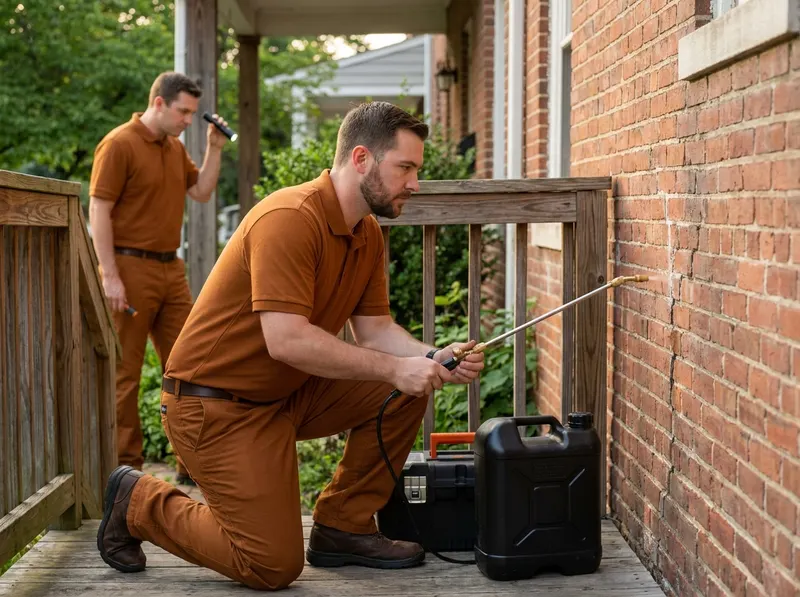
Carpenter ants are a moisture story before they are a bug story. In the Downtown Frederick Historic District, the nests we look for sit where a rowhome's wooden sill or trim has been wicking water for years — under a gutter that overshoots, behind a repointed brick section, or around a porch post that sits flat on the stone. In Baker Park and along the older streets near Hood College, mature silver maples and split shade trees hold the parent colony outdoors while a satellite colony moves into the house through a limb touching the roofline. On the newer wooded edges — Tuscarora Knolls, Clover Hill, the Villages of Urbana, and the lots backing toward the tree line off Ballenger Creek — the entry point is usually a deck ledger board, a hot tub skirt, or mulch mounded above the siding line.
The frass tells you a lot. Carpenter ant sawdust is coarse, mixed with insect body parts, and pushed out into a neat cone below a slit in the wood. Termite damage looks nothing like it: mud tubes, blistered paint, soil packed into galleries. That distinction matters in Frederick County because a pre-listing inspection near Spring Ridge or Worman's Mill can flag "wood-destroying insect" and send a homeowner into a panic that a five-minute ID resolves. We identify it before we treat it — if what you have is termites, we tell you that, and if it is a single foraging ant that wandered in from the yard, we tell you that too.
When does a one-time carpenter ant treatment fit, and when does it not? A one-time visit is the right call when there is one active nest, a fixable moisture source, and the ants are showing up along a single trail — a kitchen counter run, a bathroom vanity, a basement rim joist. The trade-off is honest: if your lot backs to woods near the Monocacy National Battlefield tree lines or the ridge below Gambrill State Park and Frederick Municipal Forest, outdoor parent colonies will keep sending scouts every spring no matter how well we treat the interior, and a recurring exterior service is the cheaper way to hold the line. We price both openly so you choose. There is no 12-month contract required to get a number out of us.
Safety and the practical side: perimeter and void work is applied where ants travel — wall voids, sill plates, exterior cracks — not broadcast across floors or countertops. Most families stay home; we will tell you exactly which rooms to keep kids and pets out of and for how long, and we keep applications away from vegetable beds and herb pots when you point them out. Where wood is already hollowed, we say plainly that treatment kills the colony but does not restore the board — the sill, joist, or trim still needs a carpenter and a gutter fix, or the next colony finds the same soft spot. Sanitation and exclusion advice comes with the visit, in writing, because that is what keeps carpenter ants out of a Hillcrest or Amber Meadows kitchen the following April.
Every job gets a firm, written price after a free on-site visit.
Tell us about your carpenter ant treatment job in Frederick and we'll send a clear, written quote — usually the same day.
 Lumetra Pest Control Service