Baiting fits the Frederick homes where trenching and drilling are the hard part. Downtown Frederick Historic District rowhomes sit on rubble-stone and brick foundations with shared party walls, brick sidewalks, and…
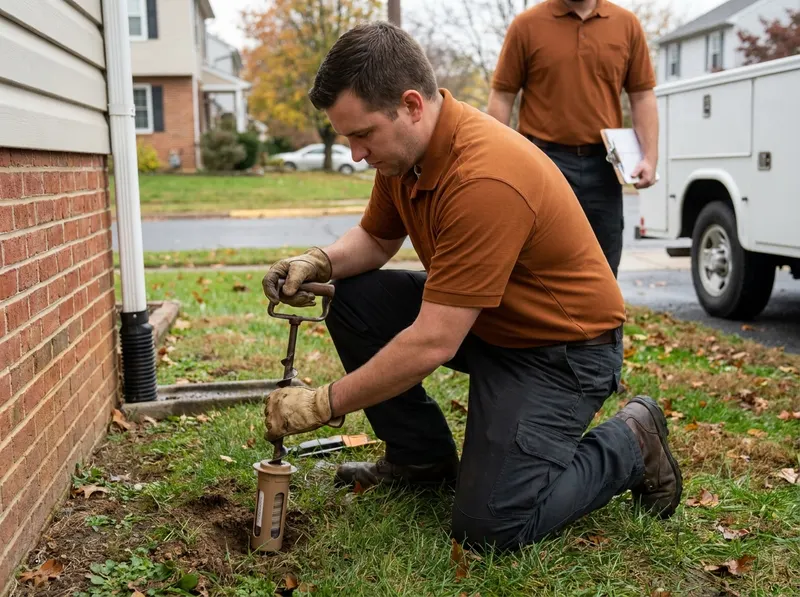
Baiting fits the Frederick homes where trenching and drilling are the hard part. Downtown Frederick Historic District rowhomes sit on rubble-stone and brick foundations with shared party walls, brick sidewalks, and narrow side yards — there is often nowhere to cut a continuous liquid trench without breaking hardscape you'd rather not break. Stations go into the soil strip, the planting bed, or a cored hole in a patio slab and sit flush with grade. The same logic applies to a Baker Park bungalow with mature maples and old stump wood near the footing, to Ballenger Creek and Clover Hill yards where the clay stays damp, and to Spring Ridge, Worman's Mill, Tuscarora Knolls, Amber Meadows, and the Villages of Urbana, where mulch beds are pushed right up against siding and slab edges. If a homeowner keeps vegetable beds or a well and wants less liquid termiticide applied along that soil line, bait is usually the more comfortable choice.
A liquid soil treatment is still the better tool in some cases, and we will say so out loud on the visit. Liquid establishes a treated zone quickly, which matters when termites are actively chewing structural framing or a sale is closing on a deadline. Bait works through the colony instead, so it is patient by design: termites have to locate the stations, recruit to them, and pass bait along before numbers collapse. The honest trade-off is speed versus access — bait avoids the drilling and gives you a monitored record year after year, while liquid gives a faster perimeter and less ongoing attention. Some Frederick homes get both: liquid on the accessible back and side walls, stations across the front walk and the finished patio.
The species behind nearly every Frederick County call is the eastern subterranean termite, and the tell most people see first is a swarm — winged insects on a warm, damp afternoon in spring, often against a basement window or a south-facing sill. The second tell is mud tubes: pencil-width soil tunnels climbing a foundation wall, a floor joist, or the back of a garage stud, and these show up constantly in pre-listing home inspections. We identify the insect and map the entry points before anything is installed, because a carpenter ant trail or a discarded swarmer wing pile from last April changes the plan entirely. Old form boards, buried scrap lumber, downspouts dumping at the footing, and mulch above the siding line are the conditions we note in writing, since fixing them makes the bait system work better and lowers the odds you repeat this in five years.
Monitoring is the part worth paying attention to. Stations are opened, the bait is inspected for feeding, spent cartridges are replaced, and each visit gets logged with a date. Feeding activity, or the absence of it, is the only real proof a colony has been dealt with — which is why we hand you the record instead of describing it over the phone. Above-ground stations can also be placed directly on an active mud tube inside a basement or crawlspace when we want termites feeding immediately rather than waiting for them to find the perimeter. Bait is used strictly per its label, and stations stay locked and below grade where kids and dogs are concerned. Nobody has to leave the house for an installation. Call (227) 800
Tell us about your termite bait system job in Frederick and we'll send a clear, written quote — usually the same day.
 Lumetra Pest Control Service