German cockroaches are the ones that make people stop using their own kitchen, and they behave predictably: they stay within roughly 10 to 12 feet of food and water, they hide in warm motor housings, and a single…
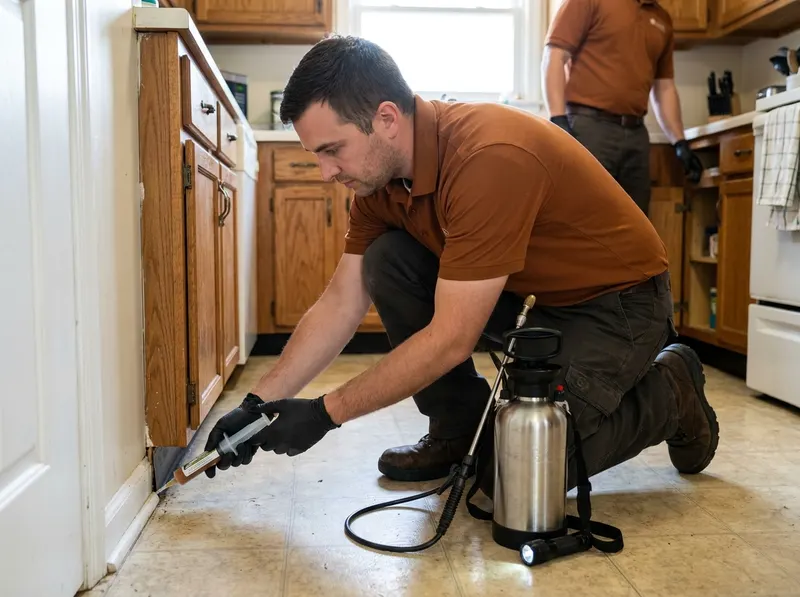
German cockroaches are the ones that make people stop using their own kitchen, and they behave predictably: they stay within roughly 10 to 12 feet of food and water, they hide in warm motor housings, and a single female carries an egg case holding about 30 to 40 eggs. That biology decides the method. Blanket spraying baseboards scatters them into wall voids and neighboring rooms, which is exactly why hardware-store foggers knock a population down for a week and then it comes back worse. We bait where they feed, treat the hinges of cabinet doors, the dishwasher and range voids, and the space under the sink where the trap sweats — then we put monitors down so the second visit is based on counted evidence, not a guess.
Which roach you have also depends on where in Frederick County you live. In Downtown Frederick Historic District rowhomes and older attached buildings near Market Street and Carroll Creek Park, shared walls, common trash areas, and a single service line mean the population is often bigger than one unit — we treat what we can access and tell you honestly when the neighbor's kitchen is part of the problem, because ignoring that is how a job fails. In slab-on-grade neighborhoods like Spring Ridge, Ballenger Creek, Villages of Urbana, and Amber Meadows, the more common visitor is an oriental or American cockroach moving up through a floor drain, a dry P-trap in an unused basement bathroom, or an expansion joint at the garage. Those calls usually need drain and moisture correction plus a perimeter treatment, not repeated interior spraying. Along the wooded edges toward Gambrill State Park and the Frederick Municipal Forest, homeowners in Tuscarora Knolls, Hillcrest, Clover Hill and Worman's Mill sometimes find large brown roaches in late spring; those are frequently Pennsylvania wood cockroaches, they don't breed indoors, and the fix is exclusion and light management rather than an interior chemical program.
Here is the honest decision. One-time cockroach treatment fits a young infestation with a known source — a few sightings in one kitchen, a unit you just moved into, or occasional invaders from outside — and it includes the follow-up verification visit. Recurring service fits attached homes, rental units, restaurant and salon kitchens, and any place where re-introduction is likely from deliveries, cardboard, laundry, or a shared wall. The trade-off is real: one-time pricing is cheaper up front but puts monitoring back on you, while a scheduled program costs more over a year and keeps monitors and bait rotation in place so a new egg case never becomes a full population. We publish both so you can choose without a salesperson in your kitchen.
Safety questions get straight answers. Gel bait and growth regulator are placed in cracks, voids, and hinge points — not sprayed across counters, toys, or a vegetable bed — and in most cockroach jobs there is no need to vacate the house beyond keeping children and pets out of a treated room until placements dry. Sanitation and exclusion do more long-term work than any product: fixing the drip under the sink, degreasing the range slides, keeping cardboard out of the pantry, and sealing the gap around the dishwasher supply line. We write those items down for you rather than treating them as our secret. Call (227) 800-4123 and describe what you saw and where — that single detail usually tells us the species before we arrive.
Every job gets a firm, written price after a free on-site visit.
Tell us about your cockroach control job in Frederick and we'll send a clear, written quote — usually the same day.
 Lumetra Pest Control Service