The species tells you the job. Paper wasps build the open, honeycomb-cell umbrella you find under deck rails, porch ceilings and shutter lips — common on the older porches around Baker Park and the Downtown Frederick…
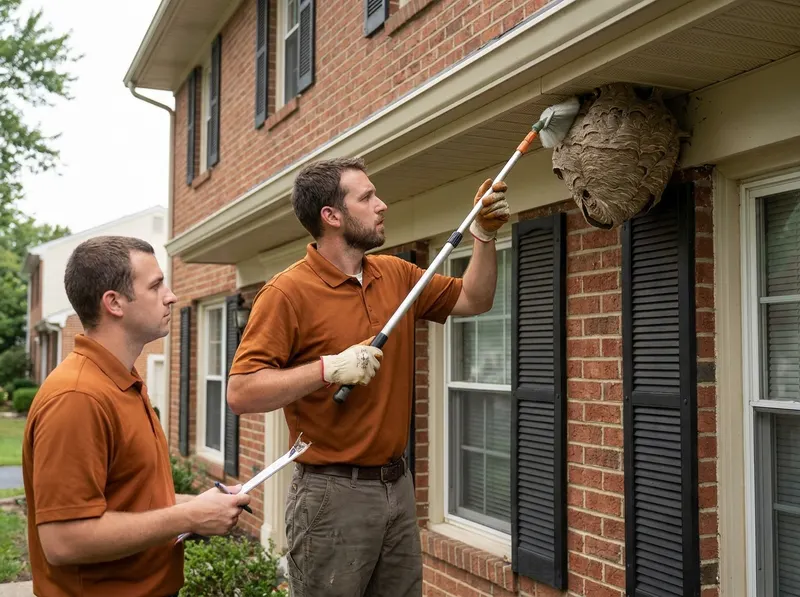
The species tells you the job. Paper wasps build the open, honeycomb-cell umbrella you find under deck rails, porch ceilings and shutter lips — common on the older porches around Baker Park and the Downtown Frederick Historic District, where painted trim and shutters give them a dry ledge. Yellowjackets go underground or into voids: a hole in the lawn, a gap under a landscape stone, a mulch bed, or the weep holes of brick veneer, which is why they turn up so often in Spring Ridge, Amber Meadows and Ballenger Creek yards during August and September mowing.
Bald-faced hornets build the enclosed gray paper nest in shrubs and low tree limbs, and European hornets — bigger, brown-and-yellow, active after dark and drawn to porch lights — favor tree cavities and second-story soffits.
One-time removal is the right call when the nest is visible, reachable and singular: one paper wasp nest over the front step in Worman's Mill, one hornet nest in a Clover Hill hedge. You pay once, the colony is done, and there is no reason for a monthly bill.
A seasonal exterior treatment makes better sense when the same eave or soffit line gets rebuilt on every year — new-construction subdivisions like Villages of Urbana and Tuscarora Knolls often have long, sun-warmed vinyl soffit runs with small gaps, and paper wasps return to the same sheltered face each spring. The trade-off is honest: one-time removal solves today's nest and nothing else, while a spring-and-summer exterior schedule costs more over the year but keeps nests from establishing where you walk, grill and let kids out the back door.
Two things Frederick homeowners should not do.
Do not knock a nest down with a hose or a broom — a disturbed yellowjacket or bald-faced hornet colony defends in numbers, and yellowjackets in particular sting repeatedly. And do not plug a wall or soffit hole with foam or caulk while the colony is alive; sealed-in yellowjackets chew toward the interior side and end up in a bedroom or a kitchen. Sealing is the last step, after the colony is confirmed dead on a follow-up look.
Timing is straightforward here. Paper wasps start small solo nests in April and May, when a single queen and a nickel-sized comb are easy and cheap to remove. Colonies peak in late August through October, which is when a yellowjacket nest in a Hillcrest lawn can hold thousands of workers and when late-season foragers get aggressive around trash cans, soda cans and fallen fruit — the same behavior people notice at picnic tables along Carroll Creek Park and on ballfield sidelines.
First hard frost kills the workers, but the empty paper nest does not need to stay: removing it takes away the sheltered footprint and the pheromone-marked site.
Safety questions get a direct answer. Products are applied to the nest and the entry point, not broadcast across a yard, so vegetable beds, pollinator plantings and play equipment stay out of the treatment.
Most exterior nest jobs do not require anyone to leave the house.
Every job gets a firm, written price after a free on-site visit.
Tell us about your wasp and hornet nest removal job in Frederick and we'll send a clear, written quote — usually the same day.
 Lumetra Pest Control Service